Wednesday, November 29, 2017

Why Shouldn’t We Trust the Non-Canonical “Gospel of Basilides”?

Why Shouldn’t We Trust the Non-Canonical “Gospel of Basilides”?

Print Friendly, PDF & Email
There are a number of ancient, non-canonical texts used by sect leaders or heretical groups in the early history of Christianity. One of these is called The Gospel of Basilides. Is this non-biblical text reliable? Was it written by an eyewitness who accurately captured the actions and statements of Jesus? There are four attributes of reliable eyewitness testimony, and the first requirement is simply that the account be old enough to actually be written by someone who was present to see what he or she reports. The Gospel of Basilides was written too late in history to have been written by anyone who could have actually seen the ministry of Jesus, and like other late non-canonical texts, this errant document was rejected by the Church. In spite of this, The Gospel of Basilides may have contained small nuggets of truth related to Jesus.  Although it is a legendary fabrication altered by an author who wanted to craft a version of the Jesus story that suited the purposes of his religious community, it likely reflected many truths about Jesus:
The Gospel of Basilides (120-130AD)
Nothing of this Gospel survives today. What little we do know about Basilides and his followers comes first from the letters of Hippolytus, Clement of Alexandria, Origen and Hegemonius (all of whom described Basilides as a heretic). Basilides was an early Gnostic teacher in Alexandria, Egypt between 117-138AD. He taught among the Persians and wrote many commentaries on the orthodox Gospels (assembled as a volume known as Exegetica). The Gospel of Basilides is mentioned by Origen, Jerome, Ambrose, Philip of Side, and Venerable Bede.
Why Isn’t It Considered Reliable?Although The Gospel of Basilides is mentioned by several early Church leaders, it is never described as anything other than heretical. Basilides is not an eyewitness to the life of Christ and does not begin teaching about Jesus until 100 years after Jesus’ life amongst the true eyewitnesses. In addition, it is clear from the writings of early Christians, that Basilides was a Gnostic heretic who reflected his theology in his writings.
How Does It Corroborate the Life of Jesus?
At the very least, what little we do know about Basilides’ work affirms that Jesus lived and his life was captured in a set of eyewitness Gospels (later referenced by Basilides in his own commentaries). These reliable Gospels were apparently in place and established well enough to provide the foundation for Basilides’ Exegetica. From the writing of Hippolytus, we can infer that Basilides acknowledged the virgin conception of Jesus, and the fact that the baby Jesus was visited by Magi who followed a star. Hippolytus also describes Basilides as acknowledging the fact that Jesus carefully controlled the timing of his ministry, quoting Jesus’ statement: “Mine hour is not yet come.”
Where (and Why) Does It Differ from the Reliable Accounts?We know very little about Basilides’ views related to the life of Jesus, but what little we do know differs significantly from the teaching of the reliable Gospels. Hippolytus said that Basilides taught that the “Divine being” of God was not joined to Jesus until His baptism. In fact, Basilides believed that Jesus did not receive “the Gospel” from God until John the Baptist baptized Him. This seems consistent with the Gnostic idea that secret knowledge is the mechanism through which individuals are enlightened and saved.
This ancient non-canonical text used by Basilides was a late, fictional alteration. When examined under the criteria we use to determine eyewitness reliability, it fails the test. The four canonical Gospels (Mark, Matthew, Luke and John) are still the earliest reliable record of Jesus, written within the lifetimes of the eyewitnesses who knew Jesus personally.

Historic Heresies Related to the Nature of Jesus

Historic Heresies Related to the Nature of Jesus

Print Friendly, PDF & Email
Historic Heresies Related to the Nature of JesusOver the centuries, believers have sometimes struggled to understand the nature of God and the great mystery of Jesus. The Bible describes Jesus as having the nature and power of God, and the Gospel of John tells us that He existed before the universe began (He was, in fact, the creator of the universe). At the same time, the Bible teaches Jesus was fully human and died on the cross. Efforts to reconcile the Divine and human nature of Jesus have resulted in a number of classic and historic misinterpretations:
Adoptionism (2nd Century)
This heresy denies the pre-existence of Christ and therefore denies His Deity. It taught Jesus was simply a man who was tested by God and after passing the test was given supernatural powers and adopted as a son (this occurred at His baptism). Jesus was then rewarded for all He did (and for His perfect character) with His own resurrection and adoption into the Godhead.
Leader(s) in the Heresy: Theodotus of Byzantium
Corrector(s) of the Heresy: Pope Victor (190-198AD)
Docetism (2nd Century)
This heresy was coined from the Greek word, “dokesis” which means “to seem”. It taught Jesus only appeared to have a body and was not truly incarnate. Docetists viewed matter as inherently evil, and therefore rejected the idea God could actually appear in bodily form. By denying Jesus truly had a body, they also denied He suffered on the cross and rose from the dead.
Leader(s) in the Heresy: Attributed to Gnostics and promoted by the Gospel of Peter
Corrector(s) of the Heresy: Ignatius of Antioch, Irenaeus, and Hippolytus refuted it was condemned at the Council of Chalcedon in 451AD
Apollinarianism (4th Century)
This heresy denied the true and complete humanity of Jesus, because it taught He did not have a human mind, but instead had a mind that was completely Divine. The heresy lessened the human nature of Jesus in order to reconcile the manner in which Jesus could be both God and man at the same time.
Leader(s) in the Heresy: Appollinaris the Younger (bishop of Laodicea in Syria), 360AD
Corrector(s) of the Heresy: The Council of Constantinople in 381AD
Arianism (4th Century)
This heresy taught Jesus was a “creature” who was “begotten” of the Father. Only God the Father is “un-begotten”. In this view, only the Father is truly God; He was too pure and perfect to appear here on earth, so He created the Son as His first creation. The Son then created the universe. God then adopted Jesus as a son (because, after all Jesus and God are not supposed to have the same nature in this view). Jesus was worshipped only because of His preeminence as the first creation.
Leader(s) in the Heresy: Arius of Alexandria Egypt (250-336AD)
Corrector(s) of the Heresy: The Council of Nicaea in 325AD. The Nicene Creed was written to respond to this heresy.
Nestorianism (5th Century)
This heresy taught Mary only gave birth to Jesus’ human nature. The founder of the heresy, Nestorius, did not even want Mary to be called “Mother of God” but instead wanted her to be called “Mother of Christ”. In essence, the heresy maintained Jesus was really two separate persons, and only the human Jesus was in Mary’s womb. If that was true, then Jesus was not God incarnate while in the womb.
Leader(s) in the Heresy: Nestorius of Antioch (Bishop of Constantinople in 428AD)
Corrector(s) of the Heresy: The Council of Ephesus in 431AD
Eutychianism [Monophysitism] (5th Century)
This heresy taught Jesus’ humanity was absorbed by His divinity. The heresy is Monophysite in nature, derived from the Greek words “mono” (“one”) and “physis” (“nature”). In essence, the heresy claimed Jesus had only one nature (something new and different than the Divine or human nature that God and humans have, respectively). Instead, this heresy taught a third unique nature was possessed by Jesus; a blend or mixture of the human and the Divine.
Leader(s) in the Heresy: Eutyches of Constantinople (380 – 456AD)
Corrector(s) of the Heresy: The Fourth Ecumenical Council in Chalcedon in 451AD. The Chalcedonian Creed addresses this heresy.
Monothelitism (7th Century)
This heresy emerged in response to the Monophysite heresy (see above), but it also taught something denied by the Scripture. The name is derived from a Greek root that means “one will”. Monothelitism taught Jesus had two natures but only one will. Instead of having two cooperative wills (one Divine and one human), Jesus had one Divine-human “energia”.
Leader(s) in the Heresy: Patriarch Sergius I of Constantinople (610 – 638AD)
Corrector(s) of the Heresy: The Third Council of Constantinople; the Sixth Ecumenical Council (680 – 681AD)
These ancient heresies have been revisited by believers over the centuries and even persist into the modern era. Unitarians, for example have embraced a view of Jesus very similar to the heretics of Arianism. The more we understand these classic heresies related to Jesus, the better prepared we will be to spot counterfeits when they re-emerge in our culture.

TZADIKKIM


http://www.chabad.org/media/pdf/1031/xbbk10317041.pdf


Rabbi Mendy Gutnick ParklandNovember 28, 2017
in response to Peter :
It is never too late to pray for the sinner to repent but you are right mercy does not mean misplaced compassion enabling evildoers thrive etc, it means asking that G-d has mercy on them and helps influence them to stop their evil ways. Even Avraham did not just ask for a reprieve for the evildoers of Sodom he asked that if there are righteous people there in the city to save the city as then they may be able to hopefully influence the sinners to change their ways. But less than 10 would carry no influence or merit to a large city and then he stopped asking. But if there were 10 maybe there would have been cause for hope and mercy. Interestingly Noach and his family were 8, perhaps had he influenced one or two more people to do good, the world may have merited salvation!

Edward L Yablonsky PhoenixNovember 28, 2017
in response to Arnold Luterman:
In these texts the story is used as a teaching lesson of what can happen if man deteriorates in his moral and ethical behavior

I think your above comment is insightful. If Noach failed to beg for mercy, would there have been a basis for mercy insofar as a complete intellectual collapse of recognizing good and evil itself did not apparently allow for that alternative,so it seems.Abraham's pleadings were equally in vain for there were none righteous in Sodom.


http://www.chabad.org/library/tanya/tanya_cdo/aid/105665/jewish/Spicy-Food.htm

If your inner life is tranquil, if no demons plague your thoughts and no dichotomies rend your being, then one of two things are true: either you are a tzaddik, or else you are a beinoni who abandoned the battlefield. So unless you are so supercilious as to consider yourself a perfectly righteous tzaddik, this inner quietude should greatly alarm you. For what meaning, significance and joy can there be in a life that brings no pleasure to G‑d?


Why are there tzaddikin and beinonim? Because G‑d desires both:

There are two types of pleasure before G‑d. The first is from the complete nullification of evil and its transformation from bitterness to sweetness and from darkness to light by the perfectly righteous. The second [pleasure] is when evil is repelled while it is still at its strongest and mightiest... through the efforts of the beinoni... As in the analogy of physical food, in which there are two types of delicacies that give pleasure: the first being the pleasure derived from sweet and pleasant foods; and the second, from tart and sour foods, which are spiced and prepared in such a way that they become delicacies that revive the soul... (Tanya ch. 27)
 Print
 Email

One day, about 200 years ago, there was a fire in hell. The whole place burned down. It was bound to happen sooner or later, with those infernal fires burning night and day and the old devils getting careless over the years.
So they called in a troop of architects, contractors and interior designers and built a brand new gehenna. They redid the whole thing, from the landscaping to the ceramic in the bathrooms. But then the righteous folk upstairs in heaven started complaining. "The wicked guys get a new, modern complex, while we're housed in this 5000-year-old dilapidated place? Is this heaven's idea of justice?" It was decided that the righteous were right. The wicked were relocated to the old paradise, which now became the new hell; and the holy folk moved into the old gehenna, which became the new heaven.

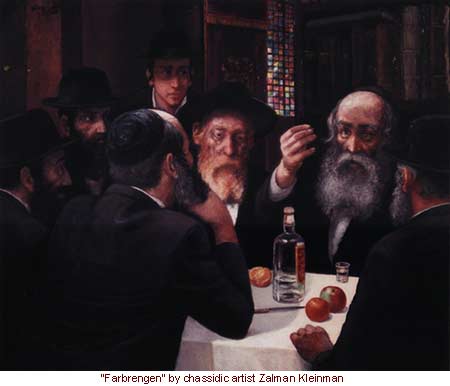
Chassidim used to tell this story to illustrate what happened when the founder of Chabad Chassidism, Rabbi Schneur Zalman of Liadi, published his 6.Tanya in 1796
On the cover page of Tanya, the author states that he is saying nothing new; all this book is, Rabbi Schneur Zalman insists, is a "collection of sayings" by authors and teachers of Torah of previous generations. Indeed, everything stated in Tanya can be found in earlier sources. But as collected and presented by Rabbi Schneur Zalman, they constitute nothing less than a revolutionary understanding of our inner self and our purpose in life.
Before the Tanya, the human condition was a spiritual hell. It was a place of dissonance, self doubt and, above all, a crushing sense of futility over the never-ending conflict between instinct and understanding. Why is it -- the typical human asked him/herself a hundred times a day -- that I desire things I don't want to desire? That I need to force myself to do what I've already decided I want to do? That I'm attracted to things that revolt me, and shy away from things I consider good and desirable? Am I such a weak and confused creature that I don't know my own mind and cannot act on my own convictions?
Before the Tanya, the typical human being often felt as if there were not one, but two selves residing within his or her body: a lower self that lusts and obsesses and grabs and greeds; and a higher self that commits and shares and is capable of awe and makes space in itself for higher truths. The typical human being yearned for tranquility, for inner quiet, for a resolution of the unending struggle within his fragmented heart. But the yearned-for tranquility never came.
In Tanya, Rabbi Schneur Zalman affirmed: yes, there are two selves inside us, and yes, they are engaged in constant battle over control of our lives. We each posses a self-focused "animal soul" which instinctively desires and craves that which preserves, nourishes, enhances and perpetuates itself. And we each have at our core an upward-focused "G‑dly soul" that is aware of its source in G‑d and strives to reunite with it as a spark craves to be absorbed in the great fire from which it emerged. Our every action, word and thought, our every motive, craving and desire, is an outcome of this ongoing battle within our hearts.
And then Rabbi Schneur Zalman drops his bombshell: this struggle, these conflicting desires, this confusion and self-doubt and inner turmoil, is not a spiritual hell. It is a spiritual heaven.
Indeed, says the Tanya, there do exist perfectly righteous individuals -- called tzaddikim -- who have resolved the conflict, whose two souls strive in harmony, whose "selfish" self has been trained and sublimated and brought in sync with their G‑dly self. But these individuals are few and far between -- a handful in each generation, perhaps a handful in the history of humankind. The rest of us are what Rabbi Schneur Zalman terms beinonim("intermediates") -- typical human beings. The rest of us arespiritual warriors, whose calling in life is to fight the battle with integrity, with gusto and with joy.
Why are there tzaddikin and beinonim? Because G‑d desires both:
There are two types of pleasure before G‑d. The first is from the complete nullification of evil and its transformation from bitterness to sweetness and from darkness to light by the perfectly righteous. The second [pleasure] is when evil is repelled while it is still at its strongest and mightiest... through the efforts of the beinoni... As in the analogy of physical food, in which there are two types of delicacies that give pleasure: the first being the pleasure derived from sweet and pleasant foods; and the second, from tart and sour foods, which are spiced and prepared in such a way that they become delicacies that revive the soul... (Tanya ch. 27)
If your inner life is tranquil, if no demons plague your thoughts and no dichotomies rend your being, then one of two things are true: either you are a tzaddik, or else you are a beinoni who abandoned the battlefield. So unless you are so supercilious as to consider yourself a perfectly righteous tzaddik, this inner quietude should greatly alarm you. For what meaning, significance and joy can there be in a life that brings no pleasure to G‑d?

Once upon a time, there was a heaven and a hell. Then, one day about two hundred years ago, the old heaven became the new hell, and the old hell was refurbished as the new heaven.


Monday, November 27, 2017

Don’t Let Musculoskeletal Pain Dominate Your Life


Don’t Let Musculoskeletal Pain Dominate Your Life

pain MusculoskeletalIf you’re suffering from short-term or ongoing musculoskeletal pain, you know how all-encompassing it can be.
Every day, every position, everything can hurt.
It’s easy to let your whole world be controlled by the discomfort.
Decisions get made on what will hurt less.
Plans get cancelled because you just can’t risk it.
You know the routine, and you know it’s no way to live.
But you don’t have to. We promise…
What IS Musculoskeletal Pain?
In spite of the fancy name, musculoskeletal pain is actually really easy to understand – it’s any pain in the muscles, ligaments, tendons and/or bones.
Your whole body may ache. The pain may make sleeping difficult, so you’re tired all the time. But even when you do rest, you’re still fatigued because the pain drains you.
Sound familiar? If so, then you’re probably dealing with musculoskeletal pain, even if you never know that name for it.
What Causes Musculoskeletal Pain?
The truth is that there are almost as many reasons for musculoskeletal pain as there are people suffering from it. It can be:
  • Wear and tear of everyday life
  • Injury or trauma
  • Overuse OR underuse
  • Poor posture
  • Sedentary lifestyle…
The list goes on and on. Because there are also specific health conditions that can cause musculoskeletal pain. Conditions like
  • Arthritis
  • Back pain
  • Repetitive strain injury
  • Muscle spam
Having a name to put to your pain is good news, but perhaps the even better news is that there is something you can do about it.
How to Treat Musculoskeletal Pain
The traditional treatment for musculoskeletal pain is NSAIDs – but they come with all the questionable and downright scary side effects.
Instead of popping an over-the-counter pain pill – or even worse, a prescription pain killer – treat musculoskeletal pain effectively AND safely, with these all-natural treatments…
Temperature therapy – Ice packs and heating pads can be your best friend when you’re in pain. The key is to use them wisely.
If your musculoskeletal pain is new, sharp, or accompanied by swelling, you’re going to want to reach for ice (and depending on how and when it started, check in with a doctor). A good, general rule is to use ice for the first two or three days, then move to heat. If, however, your pain has been around longer than that, you know it’s being caused by tension in the muscles and ligaments, then heat may be the way to go. Where ice constricts blood flow and numbs pain, heat helps relax and soothe tight, sore muscles and attachments.
Exercise – If you just groaned at the thought of hitting the gym or running a marathon because you hurt too badly, stop worrying! That’s not the kind of exercise you need when you’re dealing with musculoskeletal pain. Instead, you’re aiming for more gentle exercises that won’t exacerbate your condition. Stretching, swimming, easy walking. Even tai chi or yoga classes can be very helpful. Eventually, work your way up to simple strength exercises, so that you’re giving your muscles, bones, and joints the support they need to keep you strong.
Massage therapy – Therapeutic massage has been used for centuries to relieve musculoskeletal pain. Depending on the massage therapist you go to, they may use long, firm strokes to help relax the muscles and attachments, or they may use firm, strong pressure to release knots. Either way, talk to your massage therapist, explain your condition, and they will be able to make recommendations that will help ease your pain.
Topical pain relievers – Topical pain relievers are better for musculoskeletal pain than pain pills for many reasons. First, you can get all-natural pain relievers that have serious medication working in them – menthol and capsaicin. Just as importantly, you can use exactly the amount of pain reliever you need on the exactly source of your pain. You don’t have to flood your whole system with pain medication just because your knees hurt. And because you put the topical pain reliever directly on the site of your pain, it gets absorbed faster and goes to work almost immediately, instead of you having to wait for it to work its way through your system before it can be effective. So, find a topical pain reliever, like Soothanol X2, and get the powerful medication your pain needs, without the scary side effects.
Musculoskeletal pain can be debilitating – but it doesn’t have to be. Take your life back, with these tips and Soothanol X2.

Never Cry Wolf

This international bestseller that changed the way we look at wolves “opens new horizons in understanding animal nature and intelligence” (Newsday). 

In 1948, Farley Mowat landed in the far north of Manitoba, Canada, a young biologist sent to investigate the region’s dwindling population of caribou. Many people thought that the caribous’ conspicuous decline had been caused by the tundra’s most notorious predator: the wolf. Alone among the howling canine packs, Mowat expected to find the bloodthirsty beasts of popular conception. Instead, over the course of a summer spent observing the powerful animals, Mowat discovered an animal species with a remarkable capacity for loyalty, virtue, and playfulness.
 
Praised for its humor and engrossing narrative, Never Cry Wolf describes a group of wolves whose interactions and behaviors seem strikingly similar to our own. Mowat humanizes these animals that have long been demonized, turning the widespread narrative of the “savage wolf” on its head and inspiring many governments to enact protective legislation for the North’s most mysterious creature.

  • File Size: 2607 KB
  • Print Length: 258 pages
  • Publisher: Open Road Media (August 4, 2015)
  • Publication Date: August 4, 2015
  • Sold by: Amazon Digital Services LLC
  • Language: English
  • ASIN: B00ZJZGVXQ

Hordes of bloodthirsty wolves are slaughtering the arctic caribou, and the government's Wildlife Service assigns naturalist Farely Mowat to investigate. Mowat is dropped alone onto the frozen tundra, where he begins his mission to live among the howling wolf packs and study their waves. Contact with his quarry comes quickly, and Mowat discovers not a den of marauding killers but a courageous family of skillful providers and devoted protectors of their young. As Mowat comes closer to the wolf world, he comes to fear with them on onslaught of bounty hunters and government exterminators out to erase the noble wolf community from the Arctic. Never Cry Wolf is one of the brilliant narratives on the myth and magical world of wild wolves and man's true place among the creatures of nature. "We have doomed the wolf not for what it is, but for what we deliberately and mistakenly perceive it to be -- the mythological epitome of a savage, ruthless killer -- which is, in reality, no more than the reflected image of ourself." -- from the new preface to Never Cry Wolf.

Biography

Farley McGill Mowat (1921-2014) was born in Belleville, Ontario. The author of more than forty books, he was a popular and distinguished naturalist and conservationist whose internationally acclaimed novels, books for young readers, and memoirs have been translated into fifty-two languages and have sold more than seventeen million copies. Mowat's oeuvre includes People of the Deer; Lost in the Barrens, a recipient of Canada's Governor General's Award; The Boat Who Wouldn't Float; A Whale for the Killing; The Snow Walker; and Virguga: The Passion of Dian Fossy. 

Mowat is most widely known for his 1963 book Never Cry Wolf, which recounts his adventures as a biologist on a solo mission in 1946 to study Arctic wolves in the Keewatin Barren Lands in northern Manitoba. The book is credited with changing the stereotypically negative perception of wolves as vicious killers. New York Times op-ed columnist Nicholas D. Kristof named Mowat's The Dog Who Wouldn't Be, first published in 1957, one of the best children's books of all time.

Mowat served in World War II from 1940 to 1945, entering the army as a private and emerging with the rank of captain. He began writing professionally in 1949 after spending two years in the Arctic. He was an inveterate traveler with a passion for remote places and peoples. 

Mowat was made an Officer of the Order of Canada in 1981. In 2002 the Sea Shepherd Conservation Society named a ship for him in recognition of his activism against the whaling industry.
on March 5, 2014
Format: Paperback|Verified Purchase

on January 17, 2016
Format: Kindle Edition|Verified Purchase